

The Skirt in a Premium Wardrobe. Cuts and Choices
A premium wardrobe
The skirt in a premium wardrobe. Why one good skirt works harder than three average ones
The skirt is the most underrated piece in a woman’s wardrobe. Treated as an extra to dresses and trousers, it is in fact the most efficient thing you can buy: it goes with literally everything, changes character with your shoes and top, and in a good fabric it lasts for years without a trace of seasonality. Below I explain how to choose a skirt that works for your wardrobe, rather than just hanging in it.
Reading time: approx. 8 minutes
The economics of one good skirt
Let us start with simple arithmetic, because it shows best why a skirt is such a worthwhile purchase. One well-chosen skirt paired with four tops you already have in your wardrobe gives four different outfits. Without any extra purchase. The same skirt with a bodysuit and a blazer is an office outfit, with a light top and sandals a summer outfit, with a silk top and heels an evening look. The skirt does not change, the context does.
This is exactly the opposite of the logic of fast fashion, where you buy a whole outfit at once, wear it in one combination and put it away when you get bored. An investment piece works differently: you buy it once, well, and it plays many roles for years. A skirt is made for this like no other piece of clothing, because by nature it is half an outfit, and you add the other half freely.
That is why, with a skirt, it is worth thinking not in terms of “it’s pretty, I’ll take it”, but “how many things I already own will it go with”. The more versatile the colour and the better the fabric, the more outfits you will get out of it, and the lower the real cost per wear.
The fabric matters more than the cut
This is the most important sentence in the whole text, and the one most often ignored when buying. A skirt in a stiff, cheap material widens the silhouette however well it is cut. The same shape in a fabric with good drape slims and falls softly on the body. So before you look at the cut, touch the material. If the fabric stands up on its own and breaks into sharp folds, the skirt will stand away from you. If it falls fluidly and recovers its shape, it will follow you as you move.
A ribbed knit, known as rib, is a rewarding material in this respect: it follows the figure, stretches with your movement, does not crease when you travel, and the vertical rib visually lengthens the silhouette. The black Silville rib skirt is an example of a fabric that does all the work for you: the rib gives a texture so distinct that the outfit needs no accessories. In a similar way, the black Taggia skirt in ribbed viscoseworks, only with a smoother, cooler finish.
A separate case is fabric cut on the bias, that is, at an angle to the weave. You cannot see this technique on the hanger, only in movement: the material flows around the figure instead of clinging to it and ripples with every step. It is the most forgiving skirt cut I know, because it emphasises nothing you do not want to emphasise. If you are buying one skirt for years and hesitating over the cut, the bias is the safest choice for any figure.
Length, the first conscious decision
The length of a skirt decides the proportions of the silhouette, the occasions it suits and the shoes you will wear with it. It is the first thing worth settling before you fall in love with a particular design.
A mini lengthens the legs more than any other length and works as well with flat shoes as with heels, because the effect comes from the bare leg, not the shoe. A midi is the most versatile and at the same time the most demanding, because it ends at mid-calf, a point that can shorten the silhouette with a heavy shoe. The solution is simple: a bare ankle or a heel. An ankle length keeps a long, elegant line but stays light, as long as the fabric has good drape. We describe in detail how to match length and cut to a particular figure, hourglass, pear, apple or rectangle, on our skirt collection page.
Four roles for one skirt
Let us go back to the arithmetic from the beginning, this time in concrete terms. I will show with examples how one skirt changes character depending on what you add to it.
For the office. A skirt for work should have a high waist and a clean line. A pencil skirt or a cotton midi works well, with a bodysuit or a simple shirt tucked in, and a blazer on top. The high waist makes the waistline clear and the silhouette look put together. The beige Ossi Crochet pencil skirt is a good example of a cut that is considered stiffly formal, yet thanks to the open crochet weave becomes soft and modern.
For every day. A midi or ankle-length skirt, a simple top, flat shoes. Effortless, yet it looks like a considered outfit. The Parma cotton midi skirt is a comfortable base here: a natural fabric, a versatile length, and all the difference is made on top.
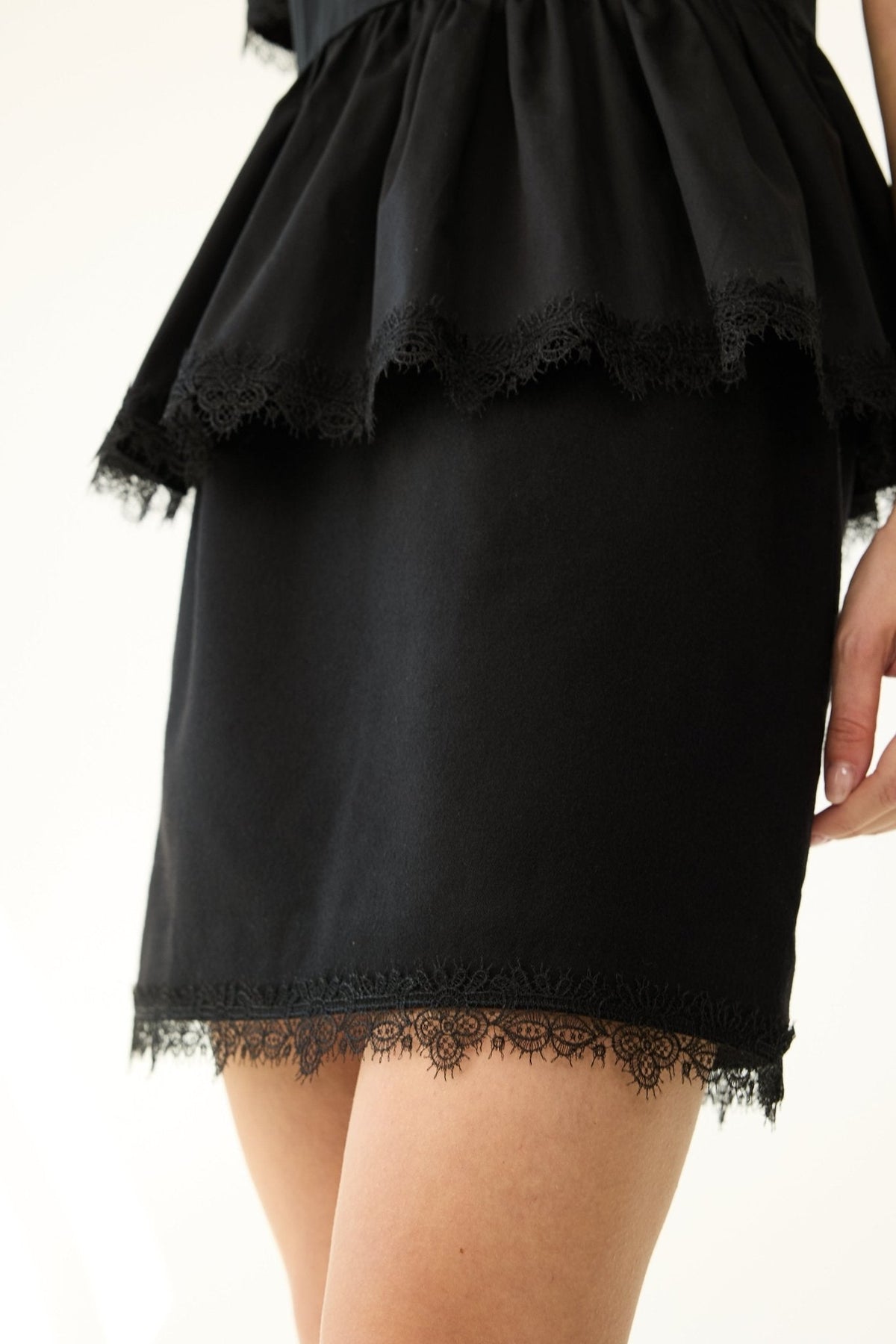
For the evening. A bias-cut or textured design, a silk top or a bodysuit with a neckline, heels. The texture of the fabric will do here what no jewellery can. If you want a festive detail, the black Adria wool skirt with lace has a narrow band of lace that makes all the difference, and paired with a plain top in the same colour it builds a coherent, monochrome silhouette.
In summer. A crochet, cotton or linen skirt, a simple top, sandals. An open weave and a natural fabric are enough to give the outfit character without accessories. The Martina white linen skirt with lace looks most beautiful with a simple top in the same shade, in an outfit built entirely on texture.
Four completely different outfits, and in each of them the skirt is a different design chosen for the role. But notice that if you took one of them, for example the black rib, it would go through all four contexts on its own, with only the top and shoes changing. That is the efficiency of a good skirt.
View our skirt collection
View our bodysuit collection
View our blazer collection
Draping and gathering: when it is worth it
Skirts with draping and gathering work on a different principle from plain cuts. They add volume and movement where you want them, and at the same time visually narrow the waist by contrast. It is a good choice especially for rectangular figures that want to mark the waistline where nature has not drawn it. The Irsina draped skirt in walnut shows how a warm, autumnal colour works with this technique: the draping gives movement, and the walnut warms the whole outfit. The same design is also available in off-white, if you prefer a lighter base.
Why we buy a skirt for years, not for a season
At Saintby we design and sew our skirts in Poland, in small series, from fabrics sourced from European producers. Short series are not a marketing decision for us, but a condition for control over every seam. With a skirt this matters especially, because a bias cut forgives the fewest workmanship errors, and a crochet weave requires a care that cannot be automated.
We do not make collections that disappear every two months. Our designs return and complement one another between seasons, so that a skirt bought a year ago still goes with what we add today. This is the practical side of the philosophy of buying for years: an investment piece only makes sense if, a year later, there is still something to wear it with. That is why we focus on colours and cuts that do not go out of fashion after a season, rather than on fashion that forces the next purchase.
Frequently asked questions
Which skirt length is most slimming?
A mini lengthens the legs the most. A midi and an ankle length slim the whole silhouette, as long as the fabric has good drape and the shoe shows the ankle or has a heel.
Is a pencil skirt only for the office?
No. It all depends on the fabric. A pencil cut in crochet or a soft material is light and modern, not formal.
Which skirt to choose if I am buying only one?
Go for a versatile colour, black or a deep neutral shade, and a fabric with good drape, ideally rib or a bias-cut design. This combination gives the most outfits from one purchase and suits every figure.
How to care for premium skirts?
Cotton and linen: wash at a low temperature. Velvet: dry cleaning or gentle hand washing, dry flat. Rib knit: wash at a low temperature, dry flat, no tumble dryer. The exact instructions are always on the label of the design.
Related articles
- How to recognise a well-made blazer. A designer’s guide
- How to choose a dress for your figure
- Black in fashion 2026
View the full Saintby skirt collection
Anna Baj, founder of Saintby

Leave a comment
This site is protected by hCaptcha and the hCaptcha Privacy Policy and Terms of Service apply.